

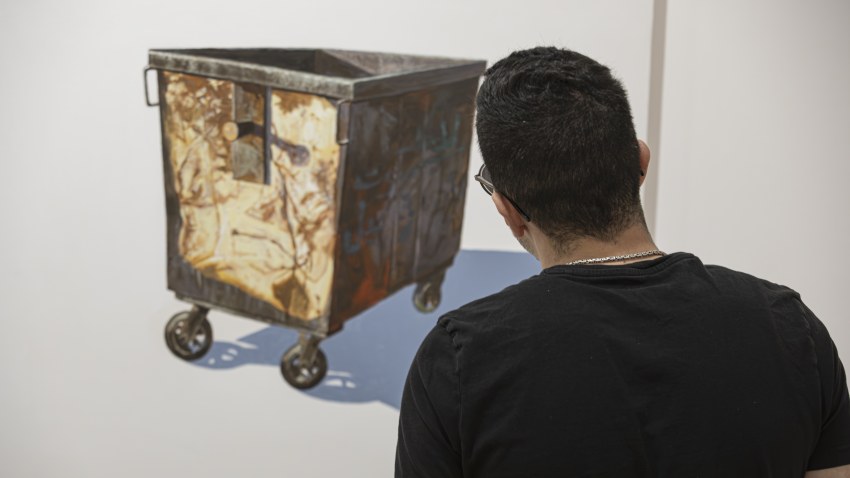
The Field of Dreams evokes a lived personal experience, stimulating memories contemplating Ramallah, a city in constant transformation. This subjective relationship is shaped by the interplay of memory, imagination, and emotion within the urban landscape, prompting critical questions around its current political reality and revealing a state of tension and temporal instability.
The exhibition includes a series of new artworks that take Ramallah as a point of departure to analyze the Palestinian context and its sociopolitical and economic transformations, as well as their impact on reality and daily life. Through compositions dominated by recurring visual elements, the works trace the material and spatial realities that shape contemporary Palestinian experience. However, these visual elements transcend the specificity of Ramallah as a particular city, becoming a lens for understanding the Palestinian contemporary city, one that languishes under settler-colonialism and the multiple structures of power that govern it. In this context, the seemingly haphazard accumulation of steel serves as a silent voice that confronts and resists the settler-colonial forces through the battle over public space: the field of dreams.
The exhibition’s title simultaneously evokes the imagery of a minefield, a place marked by the constant presence of danger, both hidden and visible. Here, dreams and mines collapse into one another, forming a constellation of contradictions in which the distance between construction and destruction, protection and siege, becomes so fragile that they are no longer separate; but coexist within the same landscape.
About the artist:
Bashar Khalaf is a Palestinian artist whose research and artistic practice examine such issues as post-Oslo shifting symbolism, the ramifications of the neoliberal project on public space in Palestine, the reproduction of meaning within present and absent archives, countermemory as a visionary tool for future liberation, and the transformations of modern Palestinian cities and spaces in relation to emancipation and freedom.